ASYS Develops Unique Gripper System with Rohde & Schwarz
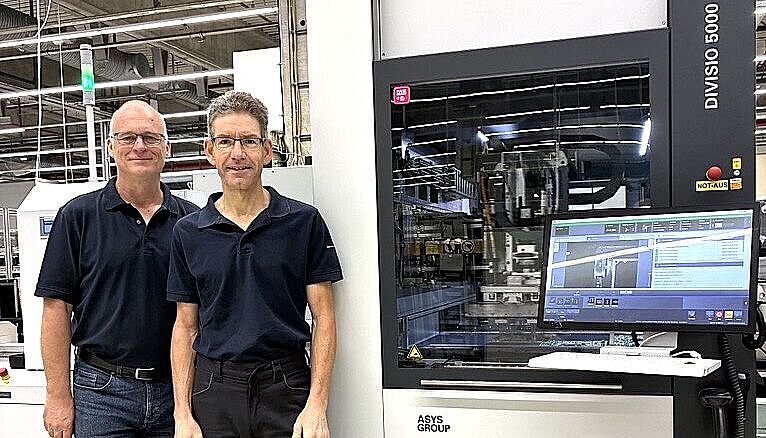
The answer was developed together. ASYS and Rohde & Schwarz created a flexible gripper system for the DIVISIO 5100 depaneling system that was specifically designed for this challenge. Not a conventional handling solution, but a system that enables an exceptional variety of product variants...
ASYS and Rohde & Schwarz created a flexible gripper system for the DIVISIO 5100 depaneling system that was specifically designed for this challenge. Not a conventional handling solution, but a system that enables an exceptional variety of product variants: six grippers, three axes, and one machine capable of automatically handling and processing a wide range of PCB designs. A gripper system that adapts to the product—not the other way around.
At Rohde & Schwarz’s electronics manufacturing facility, products are processed that are rarely seen in most factories: complex printed circuit boards for radar and communication systems, safety-critical applications, and highly specialized electronics. These assemblies can differ significantly in size, contour, weight, and available gripping points. This is where the challenge begins: How do you automate depaneling when almost every product requires a different gripping approach?
Armin Käufler, Technology Specialist at the Memmingen site, explains the motivation and starting point of the collaboration: “Due to many new products, the requirements for our depaneling system—especially regarding the grippers—increased significantly. Our previous gripping system could no longer cover this product diversity. Therefore, we approached our supplier ASYS with a clear requirement: We needed a highly flexible gripper system for our standard depaneling machine, complemented by an offline programming workstation so that machine capacity would not be blocked by program creation.”
Standard solutions quickly reach their limits in such an environment. A gripper that works perfectly for one product may be unsuitable for the next. Mechanical changeovers would consume valuable time and slow down production.
The answer did not come from a catalog—it emerged through collaboration. Together with Rohde & Schwarz, ASYS developed a flexible gripper system based on the DIVISIO 5100 depaneling platform that can adapt to a wide range of PCB designs without requiring mechanical modifications.
A solution that is virtually unique on the market in this form.
Listening Instead of Offering a Standard Solution
The path to this innovation did not begin with a predefined concept, but with extensive discussions, analyses, and testing. ASYS Application Engineer Jonas Rau supported the project from the very beginning. Together with the customer, real products were examined, gripping points were analyzed, and various scenarios were evaluated.
Hubert Ruf, Head of Technical Support at the Memmingen facility, clearly remembers how it all started:
“We approached ASYS with a clear vision and asked whether they believed a solution for our requirements was feasible—and whether they would be willing to jointly develop these new grippers to production readiness. Within a very short time, all experts were sitting together at one table and discussing ideas in a highly constructive manner. We quickly agreed: we would tackle it together.”
It soon became clear that the biggest challenge was not depaneling the PCBs themselves, but the flexible handling before and after the process. The assemblies vary considerably in width and length, contours and cutouts, board rigidity, and available gripping locations.
The objective was therefore clear: develop a gripper system capable of handling as many variants as possible without requiring mechanical conversion.
The Idea: A Gripper That Adapts
This requirement led to the concept of a modular gripper system. The solution is based on multiple gripper mounts that can be positioned flexibly. Up to six grippers can be integrated into a single handling unit.
Depending on the product, different configurations can be used:
- Single grippers for selective gripping points
- Double grippers for increased stability
- Cantilever grippers for particularly wide PCBs
The grippers can be positioned exactly where reliable gripping points are available. This enables a wide variety of assemblies to be processed on the same machine platform.
Flexible Mechanics in Detail
The grippers are mounted on multiple axes that can be positioned independently of one another. This allows the gripping width to be adjusted flexibly.
One technical detail is particularly important: the positioning of the gripper blocks is performed pneumatically using a dedicated gripper magazine.
The process works as follows:
When entering the magazine, a mechanical brake is released.
The gripper blocks are pneumatically moved into their new positions.
The brake then locks the position securely in place.
The advantage:
The grippers remain mechanically stable during operation while still allowing rapid reconfiguration whenever required.
Software as the Second Key Element
Alongside the mechanical design, software plays a crucial role. Rohde & Schwarz processes a large number of different products on the machine every day. For this reason, an offline programming concept was implemented.
Programs are not created directly on the machine but at a separate workstation:
Programming on an offline PC → Transfer to the machine → Start production
While the machine continues operating, new programs can already be prepared in parallel. This is a significant advantage, especially considering that up to approximately 1,800 programs are expected to be created annually for the system.
At the same time, the software ensures collision-free operation despite variable gripper positions, preventing interference between grippers, axes, and components.
Step by Step Toward a Production-Ready Solution
Development did not take place solely at the drawing board. Over many months, the teams:
– Tested real products
– Created programs together
– Trained operators
– Instructed additional customer personnel
Some of this work was carried out directly at the customer site, while other activities took place at ASYS.
Step by step, a solution emerged that now operates reliably in full-scale production. The Result: Maximum Flexibility on a Single Machine
The jointly developed gripper system adds a decisive capability to the DIVISIO 5100 depaneling system: true production flexibility.
Key benefits include:
– Handling of a wide variety of PCB designs
– Flexible gripper positioning
– Multiple gripper types within one machine
– Fast adaptation to new products
– Offline program preparation
– Integration into automated inline production lines
This enables even highly diverse assemblies to be processed on a single platform.
Innovation Through Partnership
For ASYS, this project is a prime example of how innovation is created—not in isolation within engineering departments, but through close collaboration with customers and interdisciplinary teamwork.
Jonas Rau, DIVISIO Application | 3rd Level Support DIVISIO at ASYS, describes the cooperation as follows: “The exchange was always on equal footing. We reviewed products together, conducted tests, and developed solutions jointly. This gripper system is the direct result of that process.”
For Hubert Ruf, the successful outcome represents far more than a technical achievement. It also reflects the pioneering spirit that has shaped Rohde & Schwarz for more than 90 years. “Rohde & Schwarz not only stands for a safer and more connected world through innovative cutting-edge technology, but also for a pioneering mindset that helps push the boundaries of what is technically possible every day. That spirit is part of our DNA. This project with ASYS embodied exactly that. Based on unrestricted trust and a genuine partnership, we created a tailor-made innovation – a gripper system that simply did not exist on the market in this form before and that fully meets our requirements in terms of quality and benefit.”
At the same time, he emphasizes that this development was only possible through the collective efforts of numerous ASYS departments. Mechanical design, assembly, and software engineering were involved from the very beginning and all contributed to the project's success.
The result is a solution that goes far beyond a conventional machine feature and demonstrates impressively how a specific production challenge can be transformed into a sustainable innovation through close partnership and the combined expertise of the entire ASYS team.